
Calf Strain Running Recovery: How Long Until You Can Run Again?
Calf Strain Running Recovery: How Long Until You Can Run Again?
Written by Alex Bell, Physiotherapist & Director
TL;DR: A running physio grades the strain, rules out look-alikes and builds a return-to-run plan around your calf strength. Expect roughly 4 to 12 weeks before you are back to full training, depending on severity. Rest it for the first few days, keep walking as pain allows and book an assessment.
- A physio confirms the grade and tests whether your calf is ready to take load.
- Recovery is roughly 4 weeks for mild strains and up to 12 for severe ones.
- Reinjury risk is highest in the first two months, so rebuild your kilometres in stages.
If you felt a sudden pull in your calf mid-run, a running physio assessment is the fastest way to find out how bad it is and when you can safely get back to training.
Most runners need roughly 2 to 12 weeks to return after a calf strain. Where you land in that range depends on the grade of the tear, which calf muscle is involved and how you rebuild your running load.
How a Calf Strain Happens When You Run
The calf works hard at every push-off, absorbing load as it lengthens and then firing to drive you forward.
Strains typically happen during sprinting, hills, intervals or a late-race surge, when fatigue meets a fast, forceful push-off.
The injury is a tear at the junction between muscle and tendon, usually in the gastrocnemius (the bigger, outer calf muscle) or the soleus underneath it. A StatPearls clinical review grades these from 1 (mild) to 3 (severe tear with possible palpable defect).
What To Do in the First Few Days
Stop the run. Rest, ice, compress and elevate, and avoid heat and massage while bleeding in the muscle is still a risk.
A 2025 narrative review in Sports Medicine suggests roughly 3 to 5 days of rest, then gentle movement and isometric work as pain allows. It also advises avoiding non-selective anti-inflammatories for the first 24 to 72 hours, so check pain relief with your GP or pharmacist.
Calf pain that comes with a hot, red, swollen leg, or breathlessness, needs urgent medical care to rule out a blood clot. The StatPearls review reports a small percetage of people clinically diagnosed with calf strain in one study had a clot instead.
How Long Until You Can Run Again?
The 2025 review reports rehab of roughly 2 to 6 weeks for mild to moderate strains and 6 to 12 weeks for severe ones.
In 149 calf strains in elite Australian footballers, a running-related mechanism was linked to a longer return to play, and a previous calf strain was linked to a much higher risk of recurrence within two seasons (Green et al., 2020, American Journal of Sports Medicine).
The same 2025 review found strains from high-impact activity averaged about 33 days to return, versus about 21 days for lower-impact mechanisms.
That matters for runners. Your mechanism is high-impact repeated loading, so plan for the longer end until your assessment says otherwise.
<
Rebuilding Calf Strength Before Kilometres
Rehab runs through phases. Pain settles first, then comes gentle loading with isometric holds and calf raises, then walking, eccentric work and progressive strengthening.
Running comes back last, usually in short walk-run blocks before continuous running, with speed work and hills held back until the calf copes with the base.
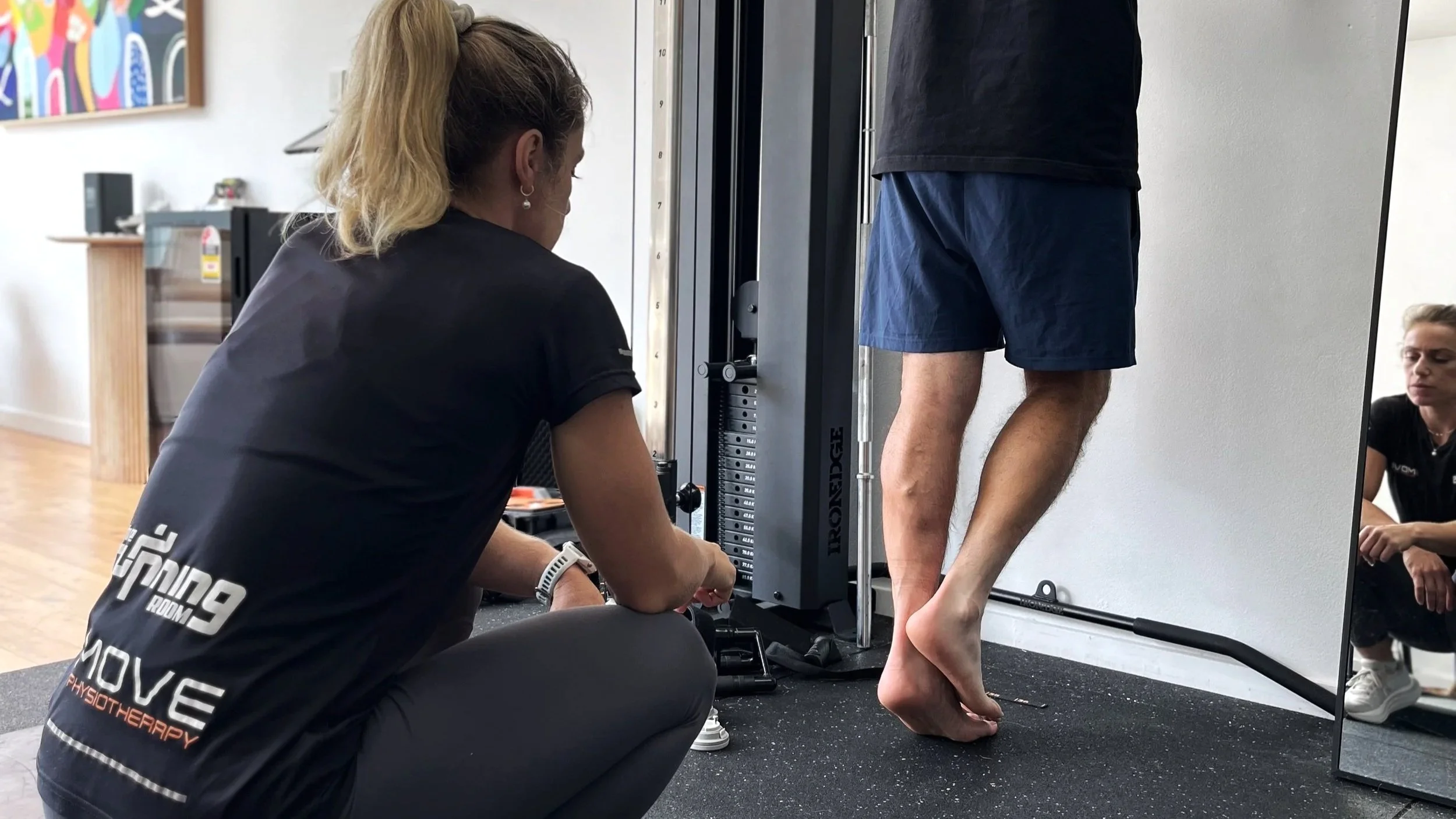
The 2025 review treats clinical assessment as the gold standard for clearing return to sport. That means no tenderness on palpation and no calf weakness on testing.
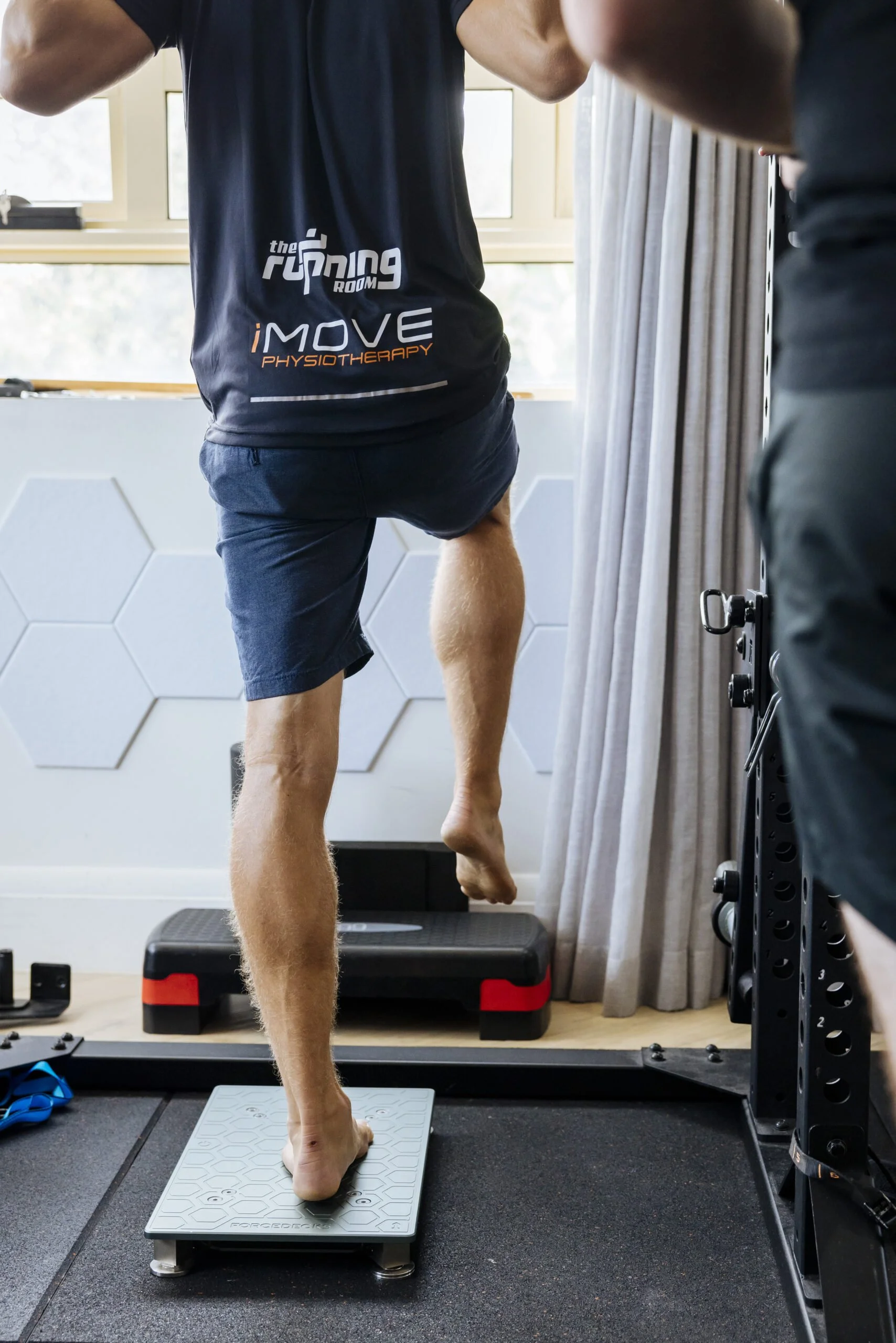
At The Running Room we can measure that strength objectively with VALD force plate and dynamometry testing, rather than relying on how the calf feels walking around the house. And that is the thing that sets us apart.
Why Calf Strains Come Back
The 2025 review found reinjury risk is highest within the first two months, likely because of returning to running too early.
In the Green study, older age and a history of calf strain raised recurrence risk, and a past ankle injury raised the risk of early recurrence.
A running assessment looks at your cadence, stride and how your calf is loaded at toe-off, and our running assessment measures this on an instrumented treadmill. Fixing the loading pattern and the training spike that caused the strain gives you the best chance of not seeing it again.
When To See a Running Physio
Whether you could limp home or finish the run, a physio assessment tells you what is actually going on, how much running you can keep doing and what your timeline looks like.
Book early if you can't walk normally, you can't rise onto your toes, the bruising is significant or the pain isn't improving after a few days.
Key Takeaways
- Book a running physio now. We can grade the strain, rule out look-alikes and plan your return around your race calendar.
- Calf strains typically happen during fast, forceful push-off, often when fatigued.
- Expect roughly 2 to 6 weeks for mild to moderate strains and 6 to 12 weeks for severe ones.
- Avoid heat and massage early, and seek urgent care for a hot, red, swollen leg.
- Rebuild calf strength first, then reintroduce running in stages.
- Reinjury risk is highest in the first two months, so do not rush the return.
If a calf strain has stopped your running, our physios can assess it and build your return around your goals. Book an assessment online at your nearest Running Room clinic.
FAQ
Can I keep running with a calf strain?
Not in the first few days. Stop running and get the injury graded. Mild strains may allow some activity early, but running through a tear risks making it bigger.
How do I tell a calf strain from a blood clot?
You can't reliably tell at home. A hot, red, swollen calf, or calf pain with breathlessness or chest pain, needs urgent medical care. A physio can screen for red flags and refer you on.
Should I stretch or massage it?
Not early. Heat and massage can increase bleeding in the first few days, and hard stretching can aggravate the tear. Your physio will tell you when to add them.
Can I cross-train while my calf heals?
Often yes, as pain allows. Pool or bike work can maintain fitness depending on the grade, and your physio can tell you what is safe for your injury.
Do I need a scan?
Not always. Many calf strains are diagnosed from your history and examination. Ultrasound or MRI is used for severe injuries, slow recovery or an unclear diagnosis.
Why does my calf keep getting strained?
A previous calf strain, a sudden jump in training load, fatigue and returning too early all raise the risk. A running assessment can look at the loading pattern behind it.
The Running Room clinics: Clovelly | Waverley | South Yarra | Gold Coast | Sydney CBD | London (Battersea, Vauxhall, East London)
Follow us on socials where we bring value to the run community.