
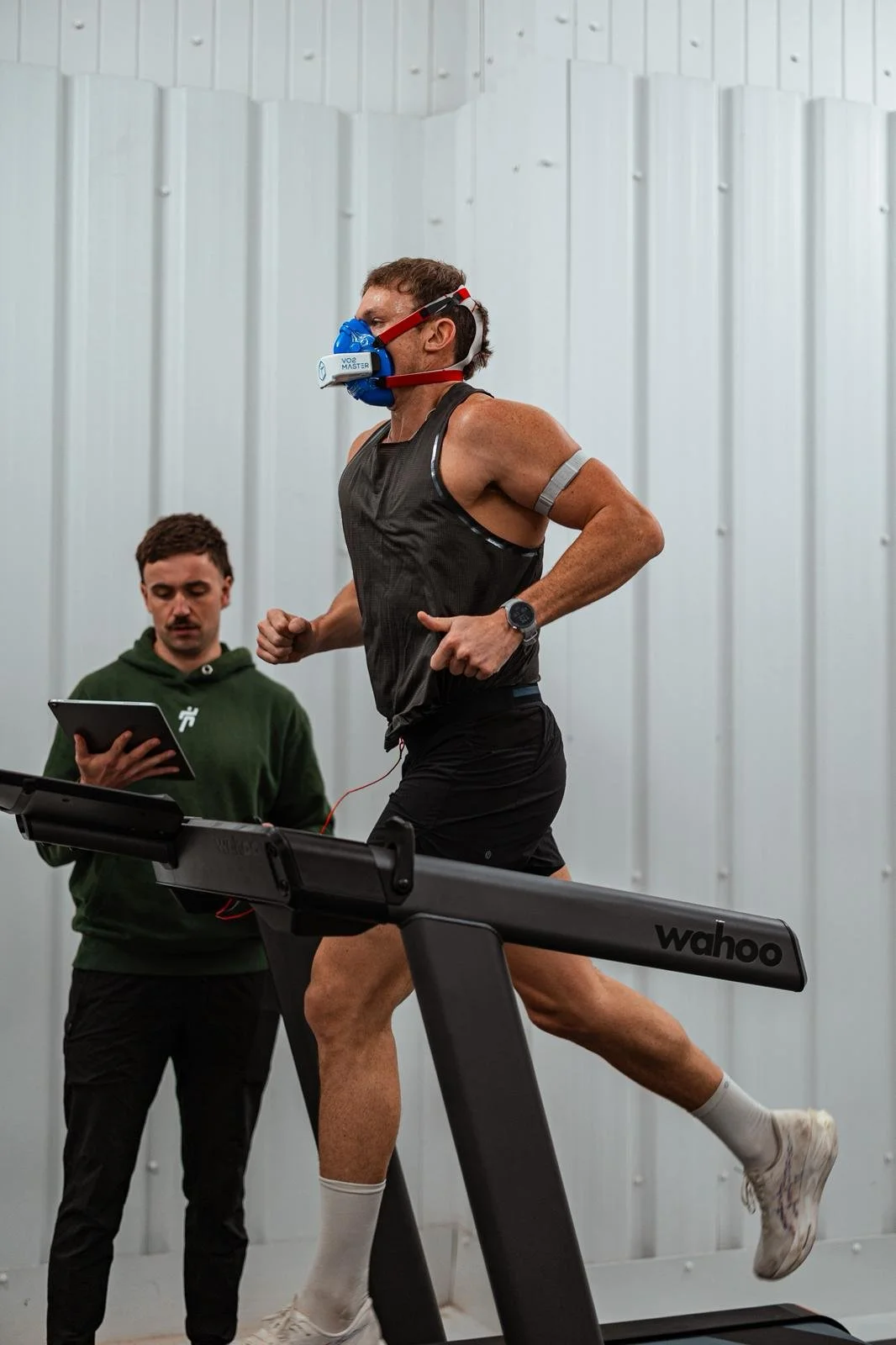

The Ground Is Never Flat
Why Camber, Tilt and RunFree Make the KICKR RUN a Genuine Training Tool
By Adrian D'Costa, Physiotherapist and Founder, The Running Room, London
There is a loop in Battersea Park that I must have run hundreds of times. It is a beautiful piece of London running: plane trees, the river on one side, the Peace Pagoda catching the light on a clear morning. It is also, from a physiotherapist's point of view, a slightly crooked surface.
Every path in that park is built to shed water. The carriageway around the perimeter has a crossfall. The tarmac paths through the middle are gently crowned so rain runs off to the edges. The riverside promenade tilts toward the Thames. Nothing about it is dramatic. Most runners have never consciously noticed it. But if you run the loop in the same direction every Tuesday for a year, one of your legs has spent that entire year landing slightly lower than the other.
That is camber. And it is one of the most underappreciated variables in the training of every road and park runner in the country.
When Wahoo asked me to spend time with the KICKR RUN, this was the feature I was most interested in. Not the top speed. Not the app integration. The fact that the deck moves side to side.
What camber actually does to a running body
First, the important part: camber is not a fault and it is not bad for you. Almost every road, path and pavement on the planet is built with a slight tilt so that rain runs off it rather than sitting on it. Battersea Park has it. So does the Thames towpath, Central Park, the streets of Melbourne and the lanes of rural Kent. It is one of the most common surfaces a human being ever runs on, and running on it is a completely normal thing to do.
What camber does is make your two legs do slightly different jobs.
When the ground tilts, one foot lands a little higher than the other. The higher leg meets the ground a fraction sooner than expected, so it rolls in slightly more through the foot and the hip works a bit harder to keep the pelvis level. The lower leg has to reach a fraction further to find the ground, so it lands more toward its outside edge and stays in contact slightly longer.
That is not a problem. If anything it is useful. Your body is being handed a marginally different puzzle on each side, and it is extremely good at solving it.
The thing worth paying attention to is repetition. Run the same loop, the same way round, every week for a year, and the same leg does the same version of that job every single time. The variety disappears. The tilt stops being an interesting challenge and becomes a fixed habit, and one side of your body quietly absorbs a slightly bigger share of the work.
That pattern often sits behind the one sided niggles I see in clinic: hip pain that only ever shows up on the left, a knee that grumbles on the right and nowhere else, an ankle that aches on the outside in someone who has never sprained it. Camber is rarely the whole story and I would never claim it is the cause. But it is frequently part of the picture, and it is almost always the part nobody has thought to ask about.
For scale, the tilt on a typical road or footway is around 2.5%. Barely noticeable underfoot. Considerably more noticeable when it is the same 2.5% under the same foot, ten thousand times.
The problem with the treadmill you already own
Here is the uncomfortable irony. The traditional answer to "the ground outside is uneven" has been "run on a treadmill instead."
But a conventional treadmill does not solve the asymmetry problem. It solves it too completely.
A standard belt is perfectly flat, perfectly level and perfectly consistent. Every single stride you take on it presents your foot with an identical surface, at an identical angle, at an identical speed. There is no crossfall to negotiate, no root to avoid, no kerb to step down, no gradient change that you did not programme in yourself.
From a tissue loading perspective, that is not neutral. That is the most repetitive stimulus available to a runner.
Healthy human movement contains variability. Stride to stride, your kinematics fluctuate slightly, and that fluctuation distributes load across slightly different portions of tissue, slightly different fascicles of muscle, slightly different regions of bone. There is a reasonable body of thinking in the overuse injury literature that reduced movement variability concentrates load rather than sharing it. When every repetition is identical, the same fibres take the same stress every time.
A flat belt at a fixed speed is variability removed by design. Which is precisely why so many runners find that six weeks of treadmill only training leaves them feeling oddly brittle when they get back outside.
What Terrain mode is doing, and why I rate it
The KICKR RUN's Terrain mode intermittently adjusts the horizontal camber of the deck while you run. Wahoo's own description is that it does this to simulate the variability of an outdoor running surface and to reduce the repetitive motion fatigue of treadmill running. The deck tilts laterally, up to around 5% to either side, and it does so unpredictably rather than on a fixed cycle. Combine it with the grade range, which runs from -3% through to 15%, and you have a running surface that changes in two planes.
That unpredictability is the whole point. Let me put my physio hat on properly.
Your ankles and feet. When the deck tilts, your foot can no longer land the same way it did on the last step. It has to accept the ground at a slightly different angle each time, which means the small muscles running down the inside and outside of your lower leg and the ones under your arch all have to wake up and do something. On a flat belt they barely get a mention. This is the exact quality people lose after rolling an ankle, and the exact quality you never build if every mile you run happens on a flat, uniform surface.
Your hips. This is the part I get most excited about. Your glutes are what stop your pelvis dropping and your knee falling inward every time you land on one leg. On a level belt that job is easy and it never changes. On a tilting deck it changes constantly. When the ground drops away under one foot, the glutes on that side have to react harder and faster to keep you level. You are training them across a whole range of positions instead of one narrow, repetitive one.
Your sense of where you are. Your brain knows where your foot and knee and hip are without you looking, because there are sensors in your joints, your muscles and the skin on the sole of your foot constantly reporting back. Those sensors are triggered by change. Give them a surface that keeps shifting and they send far more information, and your body has to act on it immediately. Foot lands, ground is not where you expected, correction happens, all inside the fifth of a second your foot is on the floor. That reflex, sensing something unexpected and fixing it before you consciously notice, is what keeps runners upright on uneven ground. It is trainable, and a flat belt does not train it.
You cannot train that on a flat belt. It is not a matter of effort. The stimulus simply is not there.
RunFree: variability in time as well as space
Terrain mode varies the surface. RunFree varies the tempo.
RunFree uses a time of flight sensor to read your position on the deck and adjusts belt speed to match your stride, keeping you centred without you touching a control. Practically, that means you are no longer running to a number. You are running, and the machine follows.
I would argue this matters as much as the tilt does, for a subtly different reason.
Fixed belt speed enforces a fixed stride. To stay on the deck at 12.5 km/h you must produce almost exactly the same cadence and stride length, stride after stride, for the duration. Outdoors you do nothing of the sort. You drift half a second per kilometre without noticing. You lift over a rise, ease on a descent, shorten around a pram on the Battersea riverside path, lengthen when a good song comes on. That natural fluctuation is a load distribution strategy your body is running without asking your permission.
RunFree gives you that back. Combined with Terrain mode, you get a running surface that varies in space and a running tempo that varies in time. That is a meaningfully closer approximation of outdoor running than anything a conventional treadmill can offer, and it is the reason I am comfortable describing the KICKR RUN as a training tool for the outdoors rather than a substitute for it.
Worth noting too: the deck is tuned somewhere between cushioning and energy return, deliberately closer to asphalt or packed dirt than to the soft, forgiving platform that most gym treadmills use. If your goal is preparing tissue for road running, that ground feel matters. A surface that absorbs everything trains a body that has never been asked to handle anything.
How I would actually programme it
Detail matters here, so here is what I would put in front of a runner in the clinic. Introduce this as you would any new stimulus. Progressively.
Weeks one and two. Terrain mode on lateral tilt only, no grade variation. Twenty to thirty minutes at a genuine easy pace, conversational. You are looking for adaptation, not fatigue. Expect some novel soreness through the peroneals, the lateral hip and occasionally tibialis posterior in the forty eight hours afterwards. That is a new stimulus landing where it should. It should settle within two sessions.
Weeks three and four. Extend to forty five minutes, or add grade variation on top of the tilt. Not both in the same week.
Ongoing. One to two Terrain sessions per week, kept at easy or steady effort. I would not run hard intervals with the tilt active, for the same reason I would not do maximal work on a wobble board. Sharpen your top end on a stable surface. Build your stability capacity at low intensity where you have the attentional bandwidth to control it.
Pair it with off feet work. The treadmill develops the reflexive, closed chain side of things. It does not build maximal capacity in the tissues doing the controlling. Keep loading single leg calf raises, both knee straight and knee bent, isometric hip abduction in a side lying position, and heavy slow single leg strength work. The two approaches complement each other; neither replaces the other.
Who I would prioritise this for. Runners returning from lateral ankle sprain who have completed their balance progressions and need a running specific stability stimulus. Runners with a history of gluteal tendinopathy or lateral hip pain, once irritability is settled. Trail and ultra runners training through a city winter who need frontal plane exposure they cannot get on London pavements. And any London based runner logging serious mileage in one direction around the same park, which is most of us.
An honest word
I want to be straightforward, because I would rather be useful than promotional.
The reasoning I have set out here is mechanistic. Lateral tilt demonstrably alters frontal plane demand at the foot and hip, and unpredictable surface change demonstrably increases proprioceptive input. Those things are well established. What we do not yet have is a body of trial evidence showing that treadmill camber simulation reduces injury rates in runners. That research has not been done. Anyone who tells you otherwise is overselling.
What I am confident saying is this: variability is a feature of healthy running that conventional treadmills systematically remove, and the KICKR RUN is the first machine I have used that puts a meaningful amount of it back. For a London runner, someone whose actual training environment is a cambered park loop and a crowned pavement, that makes it something genuinely different from a machine you run flat on while watching the clock.
The ground outside is never flat. It is about time we have a treadmill that emulates our environment.
Adrian D'Costa is a physiotherapist and the founder of The Running Room, a performance physiotherapy and running specialist clinic with locations across London.
Follow us on socials where we bring value to the run community.


